
Historical fiction author Karen A. Chase makes a case for redefining historic monuments as artifacts and letting them stand.
~~~
 Relevant History welcomes Karen A. Chase, an author and photographer, and a Daughter of the American Revolution with the Commonwealth Chapter in Virginia. Her first novel, Carrying Independence, is historical fiction about the signing of the Declaration of Independence. Karen will be a Virginia Foundation for the Humanities fellow for the 2019-2020 academic year, with full residency at the Library of Virginia. Originally from Calgary, Alberta, Canada, she is now chasing histories from Richmond, VA. To learn more about her and her books, visit her web site, and follow her on Facebook, Twitter, Instagram, Pinterest, and Goodreads.
Update 22 August 2019: Virginia Humanities has awarded Karen A. Chase a fellowship at the Library of Virginia this fall so she can work on her book project “Eliza! Eliza!: Two 18th-Century Women Who Helped Found and Expand America.” Congratulations, Karen!
*****
Today the populace tore down a statue. When the soldiers heard what their leader had done to his people—his citizens he was supposed to protect—the men lashed ropes to that big lead statue, pulled it to the ground, and hacked it to pieces.
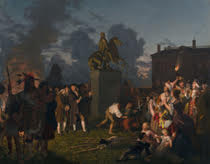 This might have been the news report from this day, 9 July, back in 1776. Soldiers of the Continental Army had gathered in Bowling Green, New York, at the feet of a statue of King George III. It had been erected just six years earlier by a populace grateful that the King had repealed the Townsend Acts. But on this day the Declaration of Independence was read aloud. The list of grievances cited against their King was long—27 points outlining an apathetic and self-appointed despot “unfit to be a ruler of a free people.”
Was it only right that early Americans rallied and destroyed the statue? It was a metaphorical and befitting end to a symbol of injustice, inequality, and entitlement.
I argue that it wasn’t just a monument. It was an artifact. Its destruction was a loss to historians, and moreover a missed opportunity to educate the populace—and us today—by adding context.
Studying art forms expands our understanding of history
Thomas Paine wrote, “The mind once enlightened cannot again become dark.” Studying the art of a time period, much like an era’s architecture or writings, illuminates previous human thought, assumptions, and actions.
This is also what artifacts do. Merriam-Webster defines an artifact as, “something characteristic of or resulting from a particular human institution, period, trend, or individual.”
When the nation abolished slavery, we did not burn Jefferson’s papers that contained notes on his slaves, or raze the slave dwellings at Monticello. Instead, historians and educators examined Jefferson’s writings and the buildings, weighing them against the writings of former slaves and the realities of human suffering resulting from Jefferson’s inability to affect a fully inclusive definition of equality. In so doing, we’ve come to learn about our collective humanity. The horrors and faults. The resilience and enlightenment.
If what has previously been defined as a “monument” is now an “artifact,” by definition we remove it from atop the pedestal and examine it differently. But words are not enough. We also need to visually place newer artifacts alongside them that show context.
The Virginia capitol is leading in the example of adding context
When Mark Warner became governor of Virginia, he was touring the grounds of the Richmond-based capitol with his family. Upon seeing all the statues of the founding fathers of Virginia lining a massive wedding-cake-style monument at the entrance, his daughter, so the story goes, asked him, “Where are all the women?”
That comment sparked a series of commissions over several years to create new, equally impressive works showcasing Virginia’s historic reality. When children in Richmond walk the grounds now, they’ll still see those founders, but marching toward them, hand raised, is Barbara Rose Johns—Richmond’s Rosa Parks—as part of the Capitol Square Civil Rights Memorial.
After careful study, and input from a broad and inclusive commission, a Native American tribute, “Mantle,” is now nestled into the historic landscape on the southwestern lawn. It is a place for reflection, representative of all Virginia’s nations, and indicative of their history and connection with the natural world.
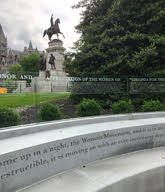 Currently being developed is also “Voices from the Garden,” the Virginia Women’s Monument. Twelve women from various periods, locations, and ethnicities are being sculpted and cast in bronze to grace an oval space to honor their achievements. Yes, Martha Washington is there, but she’ll sit alongside educator Virginia E. Randolph, and the Pamunkey Chief, Cockacoeske. The bios of all the women are on the website, and the formal dedication will come in October of this year.
The result of adding context
The result of reconsidering statues as artifacts, and adding context, does more than merely provide funding and projects for modern artists. It educates. An educated populace is a citizenry that grows up to include, contribute, and participate.
Even Thomas Jefferson wrote to Dupont de Nemours in 1816, “Enlighten the people generally, and tyranny and oppressions of body and mind will vanish like evil spirits at the dawn of day.”
For this reason alone, we should not hide or destroy our history. We need artifacts, comparisons, context, and in so doing we shall become better educated. Only then can you, and historians like me, bear witness to a broader narrative and to a truer historical understanding.
Are the sculptures we’re creating for the Virginia capitol grounds enough to heal some of the divisiveness still present about other monuments in our southern city? No. But I think of them much as I regard historical documents like the Declaration of Independence. They are a lovely beginning.
They, like that document drafted in 1776, is a promise to expand our consciousness, to listen to other voices not always our own. It is a promise to strive to be better. And that is far stronger than any monument of bronze or lead.
*****
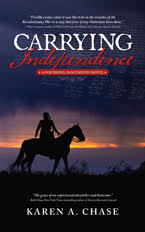 A big thanks to Karen A. Chase! She’ll give away a paperback copy of Carrying Independence to two readers who contribute comments on my blog. I’ll choose the winners from among those who comment by Friday at 6 p.m. ET. Delivery is available in the United States and Canada.
**********
Did you like what you read? Learn about downloads, discounts, and special offers from Relevant History authors and Suzanne Adair. Subscribe to Suzanne’s free newsletter.
 Relevant History welcomes Kathleen Heady, author of three mystery novels featuring Nara Blake, a woman from a Caribbean island who moves to England. Kathleen’s work in progress takes Nara to Spain, where she learns about Felicia Browne, a British woman who died fighting Fascists in the Spanish Civil War. Kathleen lives in North Carolina with her husband and two cats. Her house looks out on Carolina woods, almost fulfilling her childhood dream of living in a tree house. To learn more about her and her books, visit her
 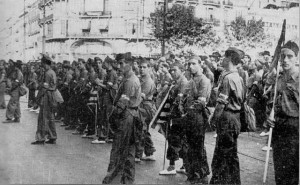 As I began research for my current work in progress, I felt drawn to that beautiful part of the world that straddles France and Spain, and the time period leading up to World War II. I looked for a connection between Britain, Spain, and the art world. This led me to discover the story of a woman named Felicia Browne, the first British volunteer and only British woman to die in the Spanish Civil War.
 The period of the Spanish Civil War is one that is still difficult to understand. It was a tragedy for the Spanish people and many others who volunteered to help the Spanish fight for freedom from fascism. The period included the tragic bombing of Guernica,
  A big thanks to Kathleen Heady! She will give away a paperback copy of Lydia’s Story to two readers who contribute comments on my blog. I’ll choose the winners from among those who comment by Friday at 6 p.m. ET. Delivery is available worldwide.
 Relevant History welcomes Clara McKenna, who writes the new historical cozy Stella & Lyndy Mysteries series about an unlikely couple who mix love, murder, and horseracing in Edwardian England. She is a member of Sisters in Crime and the founding member of Sleuths in Time, a cooperative group of historical mystery writers who encourage and promote each other’s work. With an incurable case of wanderlust, she travels every chance she gets, England being a favorite destination. When she can’t get to England, she happily writes about it from her home in Iowa. To learn more about her and her books, vist her
  Some did so willingly; some were not given a choice. America’s richest heiress, Consuelo Vanderbilt, was a spectacular example of the latter. In love with another man, she was bullied relentlessly by her mother until she agreed to marry the Duke of Marlborough. Consuelo was thought to have been heard weeping beneath her wedding veil during the ceremony. She divorced the Duke in 1920.
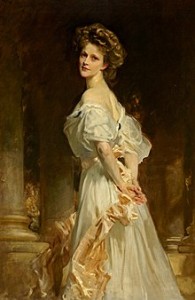 an indelible mark. Nancy Langhorne Astor, of Virginia, became the first woman to sit as a Member of Parliament. Jennie Jerome Spencer-Churchill, of New York, is best known as Prime Minister Winston Churchill’s mother. Francis Work Burke Roche of Ohio’s great-great-grandson, Prince William, will one day sit on the throne of England. So as even as Downton Abbey, the highly acclaimed television series, was inspired by these pioneering, unforgettable American women, so should we all be.
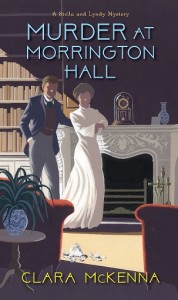 A big thanks to Clara McKenna! She will give away one hardback copy of Murder at Morrington Hall to a reader who contributes a comment on my blog. I’ll choose the winner from among those who comment by Friday at 6 p.m. ET. Delivery is available in the U.S. only.
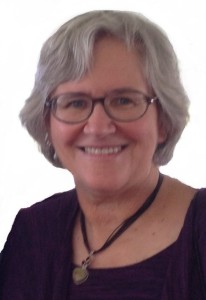 Relevant History welcomes Nancy Haines, who worked seventeen years as an engineer, then ran an antiquarian bookstore. After her retirement, she fulfilled a lifelong dream to be an author. She published a nonfiction book, We Answered with Love, about Quaker relief service in France during WWI based on the love letters of two pacifists, and a picture book about spiritual decision making for Quaker children. She is currently researching the lives of the Quakers who were the original European settlers of Hillsborough, North Carolina, where she and her husband now reside, for a nonfiction book (or possibly try her hand at a novel). To learn more about her and her books, visit her
 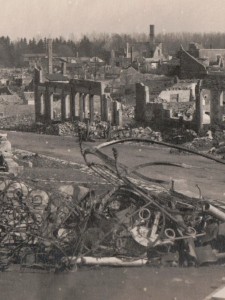 The Quakers decided to concentrate their work in Verdun, the region that was hardest hit by the German invasion. As the Allies advanced northwest of Verdun, the Army gave Quaker workers permission to move in to meet the needs of over ten thousand refugees. The fighting had been almost continuous in this area. Only about five percent of the houses were left standing and these were badly damaged. One British worker described the abandoned battlefields:
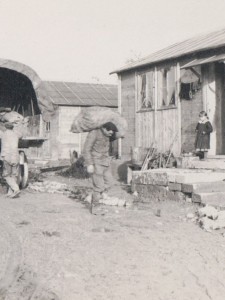 With financial assistance from the French government, the Quakers occupied the former divisional headquarters of the French and American armies. This center included barracks for the workers and barns to store supplies to support the workers, goods to be sold to the villagers, agricultural machinery, stables and breeding barns for livestock, and generators for electricity. The American Army provided trailers and fuel for distributing the supplies and building materials to the villages.
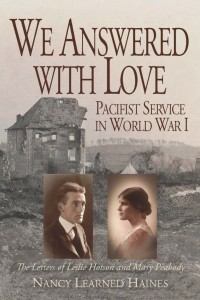 A big thanks to Nancy Haines! She’ll give away one paperback copy of We Answered with Love to a reader who contributes a comment on my blog. I’ll choose the winner from among those who comment by Friday at 6 p.m. ET. Delivery is available worldwide.
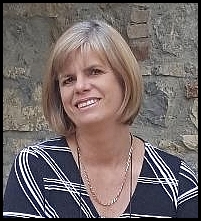 Relevant History welcomes Kathryn McMaster, a writer, entrepreneur, wife, mother, and organic farmer. She is also a bestselling author of historical murder mysteries set in the Victorian era, and modern true crime cases based on Canadian and American murders committed by young teens and couples. She co-owns the website
 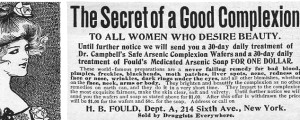 When I was at school learning about the Victorian Era of 1837–1901, we were taught about the social impact and impoverishment the Industrial Revolution brought to certain sectors of society when machinery replaced manual labor. What we were not taught was how prevalent arsenic was during this period in the production of household goods, fabric, and even beauty products used by those in the upper echelons of society.
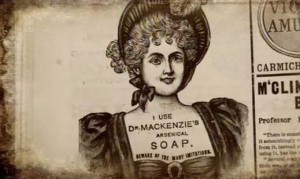 During this time in history it was discovered that by giving horses arsenic in small amounts it gave them stamina which enabled them to endure long distances. People started to dabble and found that in small doses it did the same for them. Arsenic then began to appear as an ingredient in beauty wafers and soaps. Articles in popular magazines such as Blackwoods encouraged women to bathe in it to soften their skin.
 A big thanks to Kathryn McMaster! She’ll give away one paperback copy of Blackmail, Sex and Lies to a reader who contributes a comment on my blog. I’ll choose the winner from among those who comment by Friday at 6 p.m. ET. Delivery is available worldwide.
 Relevant History welcomes Sharon Bradshaw, a historical fiction author, storyteller, and poet. Sharon loves reading archaeology books and talked to a lot of monks in the 8th century while writing the Durstan series. A Druid’s Magic is set in the real Middle-Earth we called the Dark Ages. Subscribers to
 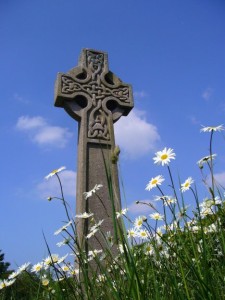 People believed in the existence of elves, faeries, and dragons in a way that was not so far removed from J.R.R Tolkien’s Middle-earth. All of this was reflected in Anglo-Saxon and Celtic art, jewelry, and weapons; ancient place names; and a belief in destiny woven through the threads of the Wyrd. The monks themselves were regarded as spellcasters. The letters they wrote were similar to the marks made by a Druid’s runes.
 Many believe that all the Druids were massacred by the Romans during the Boudican revolt c. 60-61AD. Druids in Gaul had been obliterated earlier, and historians relied for centuries on a sparse account by Tacitus (56–120AD) of what happened on the island of Anglesey. He didn’t write from personal experience, and his work is no longer regarded as impartial. Sadly the Druids didn’t leave behind an alternate version of events for us to read. Nor did they use a form of writing which would have enabled them to do so.
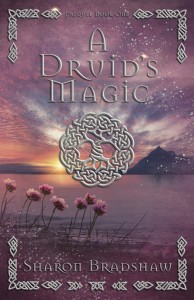 A big thanks to Sharon Bradshaw! She’ll give away one ebook copy of A Druid’s Magic to a reader in the UK who contributes a comment on my blog as well as one ebook copy to a reader in the United States who contributes a comment. I’ll choose the two winners from among those who comment by Tuesday at 6 p.m. ET.
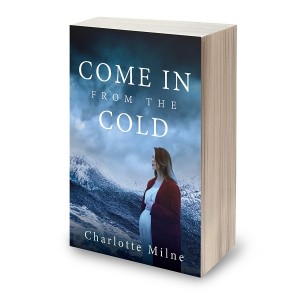
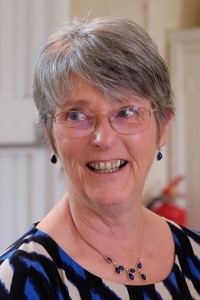 Relevant History welcomes Charlotte Milne, a naval daughter who grew up in the Scottish Borders. She worked for the Scottish National Trust, Makerere University in Uganda, and for an American software house. Although writing ‘stories’ since schooldays, she published her first novel, Dolphin Days, in 2017. Come In From the Cold (summer 2019 release), set in Scotland, tells the story of a WW2 naval officer on Russian convoys, through three generations, solving a seventy-year old murder mystery on the way. Charlotte is a keen genealogist and involved in various community-based organisations. To learn more about her and her books, visit her
 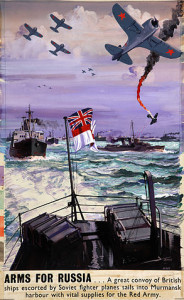 In World War 2, Roosevelt and Churchill desperately needed to prevent Russia from allying with Germany. If it did so, they knew the western allies would lose the war. In return for Russia’s alliance with the West, Stalin demanded vast amounts of food and arms for his starving and ill-equipped people. Germany and its allies blocked the land routes, so the only way to get supplies to Russia was by sea. The only ports available were within the Arctic Circle—Murmansk and Archangel—with all of Hitler’s sea and air power under orders to prevent them from reaching Russia.
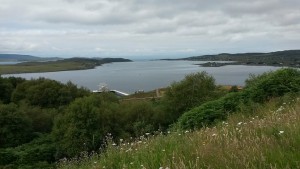 Merchant ships gathered in a deep-water anchorage in the west of Scotland called Loch Ewe. Protected by escorts of heavily-armed allied warships, they joined up with other merchant ships in Iceland, and headed, nervously, towards Russia’s only two northern open-water ports.
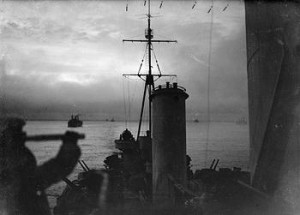 Winter storms were indescribable. The winter water temperature often dropped to minus 2 degrees Celsius, air temperature down to minus 22 degrees Celsius, without taking wind into account. Waves were often 40 to 50 feet high, visibility was nil in driving snow and spray, ships came near the vertical both going up and coming down the waves, they crashed and bounced and wallowed and capsized. Capsizing was one of the greatest dangers due to the weight of ice which accumulated above decks from the water flooding the superstructure of ships. Ice accumulated on guns, turrets and shells; masts, rigging, funnels, pipes and guard rails; on containers, aircraft, tanks and munitions stacked on decks, the decks themselves were like ice rinks, doors sealed themselves, ropes, anchors, fenders became as hard as iron and as immoveable. Clothes were inadequate—no ski jackets or cold weather gear as we know it. Crews had to spend hours on deck, tossed about like dolls, chipping at the ice and throwing it overboard, just so that the ship would not turn turtle. Fuel and oil coagulated in the low temperatures. Unimaginable conditions. Unimaginably brave men.
 A big thanks to Charlotte Milne! She’ll give away one £5 Amazon gift card to a reader in the UK who contributes a comment on my blog this week as well as one $5 Amazon gift card to a reader in the United States or Canada who contributes a comment. I’ll choose the two winners from among those who comment by Friday at 6 p.m. ET.
 Renée Dahlia is an unabashed romance reader who loves feisty women and strong, clever men. Her books reflect this, with a side-note of dark humour. Renée has a science degree in physics. When not distracted by the characters fighting for attention in her brain, she works in the horse racing industry doing data analysis and writing magazine articles. When she isn’t reading or writing, Renée wrangles a partner, four children, and volunteers on the local cricket club committee as well as for Romance Writers Australia. To learn more about her and her books, visit her
 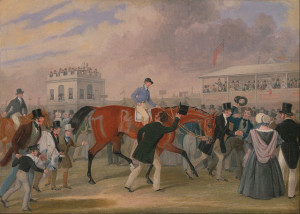 Enter “Mr Martin.” He agreed to cover the event for The Sportsman for the fee of one guinea, with full results wired at the end of the meeting. As this day was one of the few public holidays in 1898, it was a huge day for the races, and very busy with bookies. The bookies did a roaring trade on Trodmore, bigger than expected for a minor meeting but not completely unexpected for a holiday. The evening papers published the results from the major meetings held that day but didn’t publish the Trodmore results until the next day.
 A big thanks to Renée Dahlia!