
Cozy mystery author Janet Oakley recounts the fascinating history of how Volcano House Hotel near Kīlauea Crater’s rim came to be.
~~~
 Relevant History welcomes back historical fiction author Janet Oakley, a history nerd and amateur gardener. Her fiction spans the mid-19th century to WW II with characters standing up for something in their own time and place. Her writing has been recognized with a 2013 Bellingham Mayor’s Arts Award, the Chanticleer Grand Prize for Tree Soldier, Goethe Grand Prize for The Jøssing Affair, 2018 Will Rogers Silver Medallion and 2018 WILLA Silver Awards for Mist-chi-mas: A Novel of Captivity. Timber Rose was a 2015 WILLA Award finalist. A UH Manoa grad, she has special memories of the 1877 Volcano House, often teaching there. To learn more about Janet and her books, visit her web site, and follow her on Facebook and Twitter.
*****
The island of Oahu has Diamond Head. Maui has Haleakala. But neither of these compare to the Big Island of Hawai’i’s active volcano at Kīlauea. Sacred to the Hawaiian goddess, Pele, and the darling of volcanologists worldwide, Kīlauea captured the imaginations of Europeans from their very first visit in the late 1790s. Soon, travelers from all over the world began to show up to see its “lava lakes.”
Early tourists on Kīlauea Crater’s rim
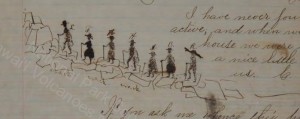 In 1823, Reverend William Ellis, an Englishman, made such a visit with American missionary, Asa Thurston. It was arduous journey of nearly twenty miles starting down by the ocean, crossing a lava desert and eventually arriving at the north end of Kilauea Crater. Ellis wrote, “We stopped and trembled.” He then went on to describe Kīlauea:
Immediately before us yawned an immense gulf, in the form of a crescent, about two miles in length, from north-east to south-west, nearly a mile in width, and apparently 800 feet deep. The bottom was covered with lava.
On the north rim of the crater, their Hawaiian guides set up a hut for the night made of “a few green branches of trees, some fern leaves and rushes…” This was most likely one of the first tourist lodgings for travelers.
The 1840s brought both sightseers and explorers to Kīlauea. Between December 1840 and January 1841, the US Exploring Expedition, led by Lt. Charles Wilkes, visited Kīlauea while doing a survey trip to the summit of Mauna Loa. With steady arrivals to the rim, a Hawaiian is said to have set up hut where he sold food to visitors. In 1846 Benjamin Pitman from Salem, Massachusetts, erected a one room grass shelter at the crater’s rim. For a dollar a day a visitor could sleep on a mat floor. He soon gave up the enterprise, but he left a name for the structure—Volcano House.
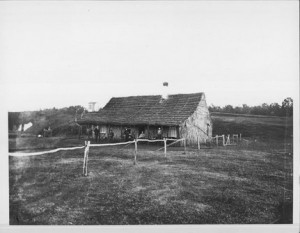 In 1866, George W.C. Jones of Keauhou, Hawaii, who had made his fortune in pulu (a popular soft fiber from the hapu’u fern and used for upholstery stuffing), went in partnership with Charles and Jules Richardson to build a more substantial wood structure. Overlooking Kilauea Crater, the building had a pili thatch roof with four bedrooms, parlor, and dining room inside. Mark Twain came for a visit in 1866 and wrote about Volcano House in Roughing It:
Neat, roomy, well-furnished and a well-kept hotel. The surprise of finding a good hotel at such an outlandish spot startled me, considerably more than the volcano did.
Six years later, another famous personage visited Volcano House. Englishwomen Isabella Bird was already well known as a travel writer and explorer when she arrived on the Big Island in 1872 to climb Mauna Loa. She later wrote of arriving at Volcano House in the dark:
Rarely was light more welcome than that which twinkled from under the verandah of the lonely crater house into the rainy night. The hospitable landlord of this unique dwelling lifted me from my horse, and carried me into a pleasant room thoroughly warmed by a large wood fire…
A new building, more visitors
By 1877, Volcano House was overflowing with visitors who came to watch Kīlauea’s live eruptions and lava lakes from the inn’s porch. It was time to build a larger, more comfortable Volcano House Hotel. The three partners hired architect Willian Lentz to accomplish this. Lentz’s design was the first Western-styled structure in Volcano. Doors, windows and building materials were brought from the coast of Keauhou on horseback and two-wheeled carts. The rafters, posts and studs for the hotel were hand hewn from native ‘ohi‘a and naio (false sandalwood) hardwood. This new inn boasted a central main room with fireplace, six guest rooms to the right of it, and a parlor and manager’s quarters to the left. Colonel John Henry and Emma Maby were hired to run it. A travel writer from San Francisco in 1880 glowed about the rooms and bed being “scrupulously clean…and the fare of excellent variety…”
In 1889, Robert Louis Stevenson visited the Big Island, but did not go up due to his health.
In 1893, Volcano House went under another remodel. A two-story addition of fourteen rooms was added onto the left end of the original structure, becoming the main part of the hotel. An observation tower and a larger dining hall were also added. The main room of the 1877 structure was now the “parlor.”
A new life and purpose
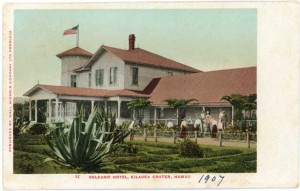 Over the decades, Volcano House changed owners several times. When the Inter-Island Steam Navigation Company took over in in 1921, a new two-story wing was built, bringing the number of rooms to 115. Sadly, the 1877 structure was sawn apart and moved to a new location away from the cliff. There it served as quarters for the hotel employees and sometimes furniture storage. In 1940, it briefly functioned as an interim lobby and bar when the 1921 Volcano House burned down. It began to fall into disrepair after today’s present hotel was built.
In 1971, nearly 100 years after it was constructed, a local photographer and architect student rented the deserted 1877 building for a wilderness photography class. The classes were so successful that the photographer approached the Park Superintendent with the idea of using the building on a permanent basis. Volcano residents interested in the arts joined in.
In 1974, permission was granted. Now listed on the National Register as Hawai’i’s oldest visitor accommodation, the 1877 Volcano House displays the works of three hundred Hawai’i artists and presents cultural programs as the Volcano Art Center. From a grass hut in the 1840s during the time of the Royal Hawaiian Kingdom through territory and statehood and its latest manifestation, Volcano House has always brought aloha to visitors coming to stand in awe of nature on the rim of the world’s most accessible volcano, Kīlauea.
*****
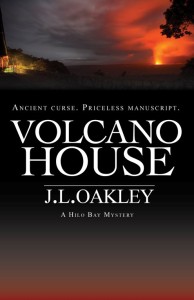 A big thanks to Janet Oakley! She’ll give away one ebook copy of her cozy mystery, Volcano House, to one person who contributes a comment on my blog this week. I’ll choose the winner from among those who comment by Friday at 6 p.m. ET. Delivery is available worldwide.
**********
Did you like what you read? Learn about downloads, discounts, and special offers from Relevant History authors and Suzanne Adair. Subscribe to Suzanne’s free newsletter.
 Relevant History welcomes back Judith Starkston, author of the award-winning historical fantasy Priestess of Ishana and the Trojan War novel Hand of Fire. She has degrees in Classics from the University of California, Santa Cruz and Cornell. Priestess of Ishana combines history with magical elements found in Hittite rites, and in the series, Queen Puduhepa is renamed Tesha after the Hittite word for “dream.” (Read the post to find out why.) To learn more about Judith and her books, visit her
 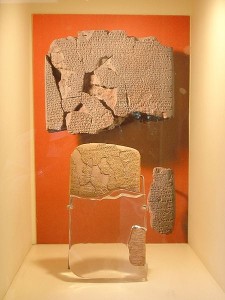 Queen Puduhepa pressed her seal into the first extant peace treaty in history. The Treaty of Kadesh was between her kingdom of the Hittites (in what is now Turkey) and Rameses II, Pharaoh of Egypt, during the Late Bronze Age, in the thirteenth century BCE. In the twentieth century, her letters, treaties, religious codifications and judicial decrees came to light when archaeologists dug up the great cuneiform libraries of her capital, Hattusha.
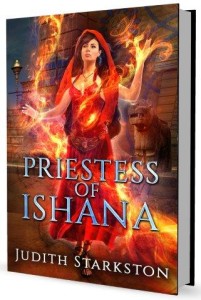 A big thanks to Judith Starkston! She’ll give away an ebook copy of Priestess of Ishana to two people who contribute a comment on my blog this week. I’ll choose the winners from among those who comment by Friday at 6 p.m. ET. Delivery is available worldwide.
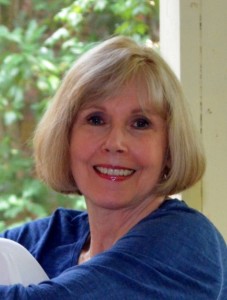 Relevant History welcomes back Anne Lovett, author of Rubies from Burma, named one of the best 100 Indie books of 2017 by Kirkus Reviews, and Maggie Award of Excellence finalist Saving Miss Lillian. With degrees from Emory University and Georgia Tech, she is the mother of three mostly adult children and lives in Atlanta with her model-railroader husband. The River Nymph is her latest release. To learn more about her and her books, visit her
 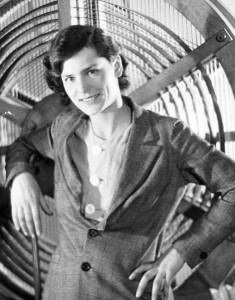 Born in 1904 Cleveland to second-generation immigrants, her father of Polish descent and her mother of Irish, Margaret White—called Maggie by her family—really didn’t begin her career until 1927. She studied at the Clarence H. White School of Photography but also spent time at four different universities.
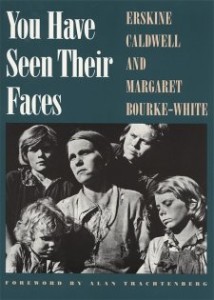 After an assignment for Life in Russia, she became interested in the lives of workers and in social conditions. As the Depression sank into the nation, she teamed with Georgia native Erskine Caldwell for a book, You Have Seen Their Faces.
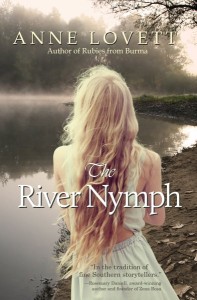 A big thanks to Anne Lovett! She’ll give away one paperback copy and one Kindle ebook copy of The River Nymph to two people who contribute a comment on my blog this week. I’ll choose the winners from among those who comment by Friday at 6 p.m. ET. For the paperback, delivery is available in the U.S. only. Delivery is available worldwide for the electronic copy.
 Relevant History welcomes Karen A. Chase, an author and photographer, and a Daughter of the American Revolution with the Commonwealth Chapter in Virginia. Her first novel, Carrying Independence, is historical fiction about the signing of the Declaration of Independence. Karen will be a Virginia Foundation for the Humanities fellow for the 2019-2020 academic year, with full residency at the Library of Virginia. Originally from Calgary, Alberta, Canada, she is now chasing histories from Richmond, VA. To learn more about her and her books, visit her
 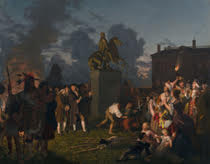 This might have been the news report from this day, 9 July, back in 1776. Soldiers of the Continental Army had gathered in Bowling Green, New York, at the feet of a statue of King George III. It had been erected just six years earlier by a populace grateful that the King had repealed the Townsend Acts. But on this day the Declaration of Independence was read aloud. The list of grievances cited against their King was long—27 points outlining an apathetic and self-appointed despot “unfit to be a ruler of a free people.”
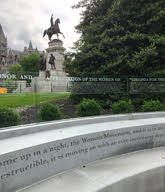 Currently being developed is also
 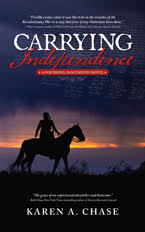 A big thanks to Karen A. Chase! She’ll give away a paperback copy of Carrying Independence to two readers who contribute comments on my blog. I’ll choose the winners from among those who comment by Friday at 6 p.m. ET. Delivery is available in the United States and Canada.
 Relevant History welcomes Kathleen Heady, author of three mystery novels featuring Nara Blake, a woman from a Caribbean island who moves to England. Kathleen’s work in progress takes Nara to Spain, where she learns about Felicia Browne, a British woman who died fighting Fascists in the Spanish Civil War. Kathleen lives in North Carolina with her husband and two cats. Her house looks out on Carolina woods, almost fulfilling her childhood dream of living in a tree house. To learn more about her and her books, visit her
 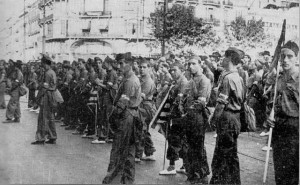 As I began research for my current work in progress, I felt drawn to that beautiful part of the world that straddles France and Spain, and the time period leading up to World War II. I looked for a connection between Britain, Spain, and the art world. This led me to discover the story of a woman named Felicia Browne, the first British volunteer and only British woman to die in the Spanish Civil War.
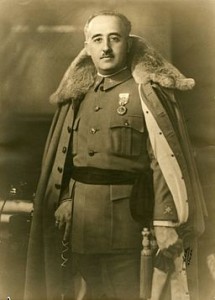 The period of the Spanish Civil War is one that is still difficult to understand. It was a tragedy for the Spanish people and many others who volunteered to help the Spanish fight for freedom from fascism. The period included the tragic bombing of Guernica,
  A big thanks to Kathleen Heady! She will give away a paperback copy of Lydia’s Story to two readers who contribute comments on my blog. I’ll choose the winners from among those who comment by Friday at 6 p.m. ET. Delivery is available worldwide.
 Relevant History welcomes Clara McKenna, who writes the new historical cozy Stella & Lyndy Mysteries series about an unlikely couple who mix love, murder, and horseracing in Edwardian England. She is a member of Sisters in Crime and the founding member of Sleuths in Time, a cooperative group of historical mystery writers who encourage and promote each other’s work. With an incurable case of wanderlust, she travels every chance she gets, England being a favorite destination. When she can’t get to England, she happily writes about it from her home in Iowa. To learn more about her and her books, vist her
  Some did so willingly; some were not given a choice. America’s richest heiress, Consuelo Vanderbilt, was a spectacular example of the latter. In love with another man, she was bullied relentlessly by her mother until she agreed to marry the Duke of Marlborough. Consuelo was thought to have been heard weeping beneath her wedding veil during the ceremony. She divorced the Duke in 1920.
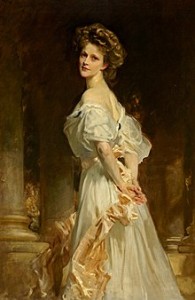 an indelible mark. Nancy Langhorne Astor, of Virginia, became the first woman to sit as a Member of Parliament. Jennie Jerome Spencer-Churchill, of New York, is best known as Prime Minister Winston Churchill’s mother. Francis Work Burke Roche of Ohio’s great-great-grandson, Prince William, will one day sit on the throne of England. So as even as Downton Abbey, the highly acclaimed television series, was inspired by these pioneering, unforgettable American women, so should we all be.
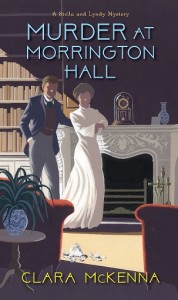 A big thanks to Clara McKenna! She will give away one hardback copy of Murder at Morrington Hall to a reader who contributes a comment on my blog. I’ll choose the winner from among those who comment by Friday at 6 p.m. ET. Delivery is available in the U.S. only.
 Relevant History welcomes Nancy Haines, who worked seventeen years as an engineer, then ran an antiquarian bookstore. After her retirement, she fulfilled a lifelong dream to be an author. She published a nonfiction book, We Answered with Love, about Quaker relief service in France during WWI based on the love letters of two pacifists, and a picture book about spiritual decision making for Quaker children. She is currently researching the lives of the Quakers who were the original European settlers of Hillsborough, North Carolina, where she and her husband now reside, for a nonfiction book (or possibly try her hand at a novel). To learn more about her and her books, visit her
 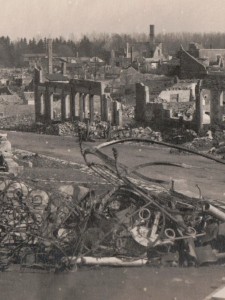 The Quakers decided to concentrate their work in Verdun, the region that was hardest hit by the German invasion. As the Allies advanced northwest of Verdun, the Army gave Quaker workers permission to move in to meet the needs of over ten thousand refugees. The fighting had been almost continuous in this area. Only about five percent of the houses were left standing and these were badly damaged. One British worker described the abandoned battlefields:
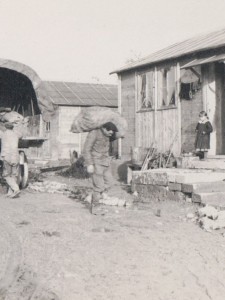 With financial assistance from the French government, the Quakers occupied the former divisional headquarters of the French and American armies. This center included barracks for the workers and barns to store supplies to support the workers, goods to be sold to the villagers, agricultural machinery, stables and breeding barns for livestock, and generators for electricity. The American Army provided trailers and fuel for distributing the supplies and building materials to the villages.
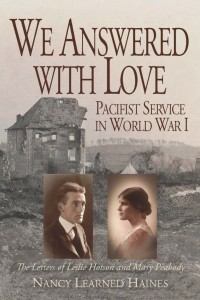 A big thanks to Nancy Haines! She’ll give away one paperback copy of We Answered with Love to a reader who contributes a comment on my blog. I’ll choose the winner from among those who comment by Friday at 6 p.m. ET. Delivery is available worldwide.
 Relevant History welcomes Kathryn McMaster, a writer, entrepreneur, wife, mother, and organic farmer. She is also a bestselling author of historical murder mysteries set in the Victorian era, and modern true crime cases based on Canadian and American murders committed by young teens and couples. She co-owns the website
 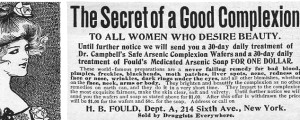 When I was at school learning about the Victorian Era of 1837–1901, we were taught about the social impact and impoverishment the Industrial Revolution brought to certain sectors of society when machinery replaced manual labor. What we were not taught was how prevalent arsenic was during this period in the production of household goods, fabric, and even beauty products used by those in the upper echelons of society.
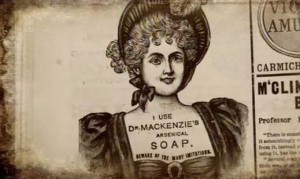 During this time in history it was discovered that by giving horses arsenic in small amounts it gave them stamina which enabled them to endure long distances. People started to dabble and found that in small doses it did the same for them. Arsenic then began to appear as an ingredient in beauty wafers and soaps. Articles in popular magazines such as Blackwoods encouraged women to bathe in it to soften their skin.
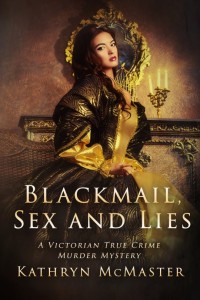 A big thanks to Kathryn McMaster! She’ll give away one paperback copy of Blackmail, Sex and Lies to a reader who contributes a comment on my blog. I’ll choose the winner from among those who comment by Friday at 6 p.m. ET. Delivery is available worldwide.
 Relevant History welcomes Sharon Bradshaw, a historical fiction author, storyteller, and poet. Sharon loves reading archaeology books and talked to a lot of monks in the 8th century while writing the Durstan series. A Druid’s Magic is set in the real Middle-Earth we called the Dark Ages. Subscribers to
 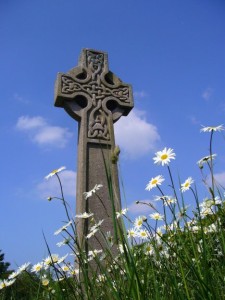 People believed in the existence of elves, faeries, and dragons in a way that was not so far removed from J.R.R Tolkien’s Middle-earth. All of this was reflected in Anglo-Saxon and Celtic art, jewelry, and weapons; ancient place names; and a belief in destiny woven through the threads of the Wyrd. The monks themselves were regarded as spellcasters. The letters they wrote were similar to the marks made by a Druid’s runes.
 Many believe that all the Druids were massacred by the Romans during the Boudican revolt c. 60-61AD. Druids in Gaul had been obliterated earlier, and historians relied for centuries on a sparse account by Tacitus (56–120AD) of what happened on the island of Anglesey. He didn’t write from personal experience, and his work is no longer regarded as impartial. Sadly the Druids didn’t leave behind an alternate version of events for us to read. Nor did they use a form of writing which would have enabled them to do so.
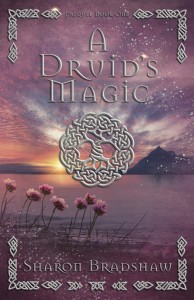 A big thanks to Sharon Bradshaw! She’ll give away one ebook copy of A Druid’s Magic to a reader in the UK who contributes a comment on my blog as well as one ebook copy to a reader in the United States who contributes a comment. I’ll choose the two winners from among those who comment by Tuesday at 6 p.m. ET.