
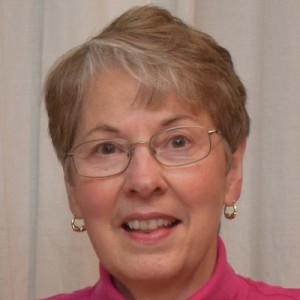
 Relevant History welcomes M. Ruth Myers, who received a Shamus Award from the Private Eye Writers of America for Don’t Dare a Dame, the third book in her Maggie Sullivan mystery series. The series follows a woman private investigator in Dayton, Ohio, from the end of the Great Depression through the end of WW2. Other novels by the author, in various genres, have been translated, optioned for film, and condensed for magazine publication. She earned a Bachelor of Journalism degree from the University of Missouri J-School and worked on daily papers in Wyoming, Michigan and Ohio. To learn more about Ruth and her books, visit her
web site and blog, and follow her on Facebook, Twitter, Goodreads, and Pinterest.
*****
Time constraints cause most survey history classes to focus on generals and royalty; statesmen; luminaries in the arts and sciences. Small wonder ordinary folks like most of us feel no connection to such distant people and see no link between their world and ours today.
That’s why I’m currently writing the fifth book in a mystery series about a woman private eye in 1930s and 1940s Dayton, Ohio. Yes, she carries a .38 and keeps a bottle of gin in her office desk like her male counterparts. But she lives in an all-woman rooming house, as was typical for America’s first-wave career women. She’s slighted because of her gender. When her bank account runs low, she eats sardines and crackers to stretch her money. In other words, she’s an ordinary person with worries much like our own, but living in times much different than ours. We can identify with her, yet the world she inhabits is just a bit exotic.
Her name is Maggie Sullivan, and I created her for two reasons.
First, I wanted to bring to life the American women of what’s widely known as the Greatest Generation, the generation that on the battlefield and at home was the lifeblood of World War II. Most movies and novels depict them as sweethearts left behind or as Rosie the Riveter, or dancing with GI’s at USO dances. In recent years, belatedly, and usually pegged to an occasion like Veterans Day, an article here and there recognizes the women who flew military planes from one base to another or performed similar auxiliary functions.
The women overlooked
Overlooked are the countless women who stepped into jobs on newspapers, in shops and offices, as cartoonists or university instructors to keep the country moving. During World War II, the number of American women working outside the home increased from 25% to 36%.
Unmentioned is the shortage of housing women faced as they flocked to cities to enable American factories to produce vital supplies. In San Diego, with its booming aircraft industry, many single women were forced to sleep in shifts in a single room. In Washington, D.C., both genders searched the obituaries in order to pounce on apartments that became available.
In Dayton, Ohio, young women who had trained as teletype operators arrived to work at what is now Wright-Patterson A.F.B. Shortage of barracks meant many had to live miles away in the city’s YWCA or in boarding houses where they shared a laundry tub and a kitchen in the basement, riding to their around-the-clock shifts in an unheated bus with hand straps and a few bench seats.
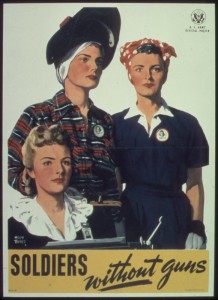 Housing was just one of the hardships faced by women whose husbands flooded into the military. If they wanted to live with their husband while he was in training, they’d find themselves sharing an apartment with another couple, or living in a lean-to, possibly with no bathtub. Nor were they always welcomed by locals. Two teachers from Missouri recall being called “low-down soldiers’ wives” and “damn Yankees” when they went to see their husbands at Ft. Knox, KY. The “rooms” they managed to find consisted of cots in the hall of rooming houses. When their husbands shipped out, women knew they wouldn’t see them again until the war ended—or they came home too badly wounded for further service. Because the military censored letters from men in uniform, the women at home didn’t even know the country where they were stationed.
Relatable history
My second goal in writing the Maggie Sullivan mysteries was to make history relevant by helping some of my readers recognize that people are still alive in their own families who, if not part of the Greatest Generation itself, have childhood memories of the 1940s or remember a parent or grandparent talking about that era. Readers can compare history with things in their own experience: rotary phones to cell phones; snail mail to real-time Skype conversation with loved ones in distant places; World War II rationing of food, clothes and other essentials to current day flag bumper stickers. If you have a female relative who did something interesting on the World War II home front, I invite you to contribute photos and share her story.
Through Maggie Sullivan and her friends on the home front, I attempt to show ordinary Americans, a typical Midwestern community, and American society itself, as they move from a sort of innocence in the waning years of the Great Depression into and through the reality of World War II. If I’ve done my job right, readers will be able to hear the click of heels on the wooden floor at McCrory’s five and dime and see people from all walks of life pulling together to support their fighting men. If I’ve done my job right, they’ll be able to touch history.
*****
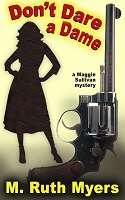 A big thanks to M. Ruth Myers. No Game for a Dame (Maggie Sullivan #1) is available free for Kindle, Nook, Apple, and Kobo. (Note: No Game for a Dame is an excellent read. I posted a five-star review for it on Amazon.) In addition, Ruth will give away a paperback copy of Don’t Dare a Dame (Maggie Sullivan #3) to someone who contributes a comment on my blog this week. I’ll choose the winner from among those who comment by Friday at 6 p.m. ET. Delivery is available in the U.S. only.
**********
Did you like what you read? Learn about downloads, discounts, and special offers from Relevant History authors and Suzanne Adair. Subscribe to Suzanne’s free newsletter.
 Relevant History welcomes Susan Higginbotham, a prize-winning author who has published historical fiction and biography. Her latest historical novel, Hanging Mary, her first to be set in the United States, is narrated by Mary Surratt and her young boarder, Nora Fitzpatrick. To learn more about Susan and her books, visit her
  In March, Sarah once again made the hazardous trip North, this time staying overnight at the Surratt boardinghouse, much to the interest of Mary’s boarder Louis Weichmann, who gave up his bedroom for the veiled lady. General Edwin Gray Lee, a Confederate agent based in Montreal, wrote on 22 March that he had “helped . . . to get the messenger off. I pray she may go safely.” On 25 March, Sarah arrived once again at the Surratt boardinghouse. This time, Mary and John Surratt traveled with her to Maryland, where they were met by the distressing news that Howell, who had been assigned to take Sarah across the Potomac and then to Richmond, had been arrested. John Surratt took it upon himself to take Sarah to Richmond, where they remained until 1 April. Two days later, they arrived in Washington, to be greeted with the news that Richmond had fallen to the Union. The next morning, 4 April, they went North again. It was Sarah’s last mission for the Confederacy.
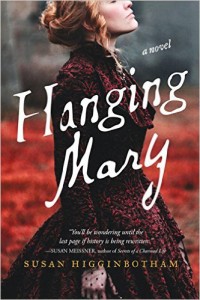 A big thanks to Susan Higginbotham. She’ll give away a paperback copy of Hanging Mary to someone who contributes a comment on my blog this week. I’ll choose the winner from among those who comment by Friday at 6 p.m. ET. Delivery is available in the U.S. only.
 Relevant History welcomes former magazine editor and freelance writer Carolyn Mulford, who worked on five continents before making the transition to fiction. Thunder Beneath My Feet is her second middle grade/young adult historical novel. The Missouri Center for the Book selected the first, The Feedsack Dress, as the state’s Great Read at the 2009 National Book Festival. Show Me the Ashes, the fourth in her award-winning contemporary mystery series for adults, will be released in hardback and ebook on 16 March. To learn more about her and her books, visit her
 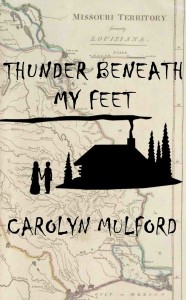 A big thanks to Carolyn Mulford. She’ll give away a paperback copy of Thunder Beneath My Feet to someone who contributes a comment on my blog this week. I’ll choose the winner from among those who comment by Friday at 6 p.m. ET. Delivery is available in the U.S. only.
 Relevant History welcomes Judith Starkson, who writes historical fiction and mysteries set in Troy and the Hittite Empire. Her debut, Hand of Fire, set within the Trojan War, combines history and legend in the untold story of Achilles’ captive Briseis. Hand of Fire was a semi-finalist in the prestigious M.M. Bennett’s Award for Historical Fiction. Starkston’s upcoming mystery series features Queen Puduhepa of the Hittites and won the San Diego State University Conference Choice Award. Puduhepa signed the first surviving peace treaty in history with Pharaoh Ramesses II; now she’s a sleuth. Ms. Starkston is a classicist (B.A. UC, Santa Cruz, M.A. Cornell). For more information, visit her
 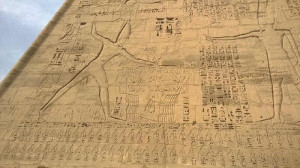 [Ramesses smiting the Hittites, Ramesseum, Photo by Morgana] In Egypt following the Battle of Kadesh in 1274 BCE, Pharaoh Ramesses ordered a version of this battle carved onto walls of his Ramesseum, his memorial temple to himself (as well as some other buildings—repetition was a virtue in his propaganda efforts). The Pharaoh, giant-sized, is shown crushing the very tiny Hittites single-handedly with his scepter. You would assume from this grand and heroic scene that Ramesses had retaken all the disputed lands in Syria from the Hittites, that he was the undisputed victor. Pharaohs get to tell history their way in their own land. Who’s going to argue with a god who rules the land with absolute authority? (More or less, putting aside those pesky uppity priests and internecine family squabbles, etc.)
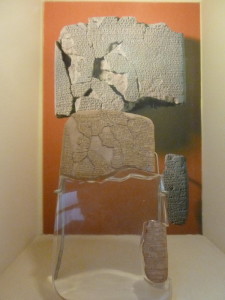 [Treaty of Kadesh between Ramesses and Hattusili/Puduhepa]It was a war whose large scale had done permanent damage to both sides, and these two sides eventually signed the first extant peace treaty in history, which you can see in the Istanbul Archaeological Museum. By that time, younger brother Hattusili was Great King and his indomitable wife, Puduhepa, also placed her seal on this treaty. Queens got a lot of respect among the Hittites, not at all like most of their ancient contemporaries.
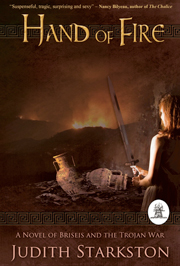 A big thanks to Judith Starkson. She’ll give away a paperback copy of Hand of Fire to someone who contributes a comment on my blog this week. I’ll choose the winner from among those who comment by Friday at 6 p.m. ET. Delivery is available in the U.S. only.
 Relevant History welcomes Sheila York who, after a successful career in TV and radio, began writing novels combining her love of mystery, history and the movies. Her series features screenwriter Lauren Atwill (and her lover, private detective Peter Winslow) chasing killers in the last hurrah of the Great Golden Age of Film. Sheila’s first novel, Star Struck Dead, won a Daphne du Maurier award. Lauren’s latest adventure, No Broken Hearts, was praised by Charles Todd: “If you love a terrific mystery, York is a must read!” To learn more about her and her books, visit her
  In the late 1920s, films began to speak; reformers could be shocked by what they saw and heard. And they saw and heard plenty. When the Depression cut into box office, studios discovered sex and violence could sell tickets. Tommy-gun-toting gangsters ruled in films like Little Caesar. Mae West brought her shocking double-entendres to Hollywood.
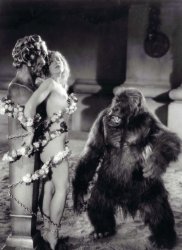 And Mr. DeMille made a movie called—I’m not kidding—The Sign of the Cross. Orgies, Christians sacrificed, Claudette Colbert bathing naked. The theory seems to have been that this would demonstrate Roman degeneracy.
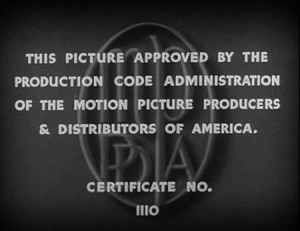 Finally the MPPDA ceded full power to control content. Beginning 1 July 1934, films could not be distributed without the Code seal of approval. The Code finally had teeth. Joe Breen, a public relations man and movie lover with excellent Church connections, ruled the Code Office for the next twenty years.
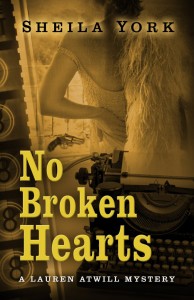 A big thanks to Sheila York. She’ll give away hardback copy of No Broken Hearts to someone who contributes a comment on my blog this week. I’ll choose the winner from among those who comment by Friday at 6 p.m. ET. Delivery is available in the U.S. only.
 Relevant History welcomes back Anna Castle, who writes the Francis Bacon mysteries and the Lost Hat, Texas mysteries. She’s earned a series of degrees—BA Classics, MS Computer Science, and PhD Linguistics—and has had a corresponding series of careers—waitressing, software engineering, assistant professor, and archivist. Writing fiction combines her lifelong love of stories and learning. To learn more about her and her books, visit her
 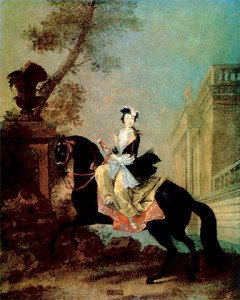 Most barristers would have ridden their own horses with their own handmade saddles and a servant or two to carry their packs and keep them company. Women traveled on horseback as well. They could choose to ride astride or sidesaddle. The sidesaddle was improved by Catherine de Medici in the sixteenth century, making it easier for women to control their mounts and thus ride independently.
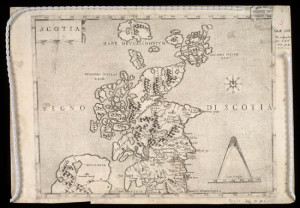 There were maps aplenty in those days—map-making was a booming craft—but they weren’t meant to aid travelers on land. Maps of coastlines, made by sailors, were amazingly good, but interior spaces were not often well represented. The Tudors were just beginning to get England’s roads organized into some kind of system. This map gives you an overall sense of Scotland’s topography, but it won’t get you from Glasgow to Edinburgh.
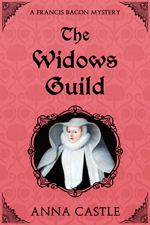 A big thanks to Anna Castle. She’ll give away an ebook or autographed paperback copy of The Widows Guild, her third Francis bacon mystery, to someone who contributes a comment on my blog this week. I’ll choose the winner from among those who comment by Friday at 6 p.m. ET. Delivery is available worldwide for the ebook and the U.S. only for the paperback.
 Relevant History welcomes Kathy Lynn Emerson, aka Kaitlyn Dunnett, author of over fifty books. She won the Agatha Award in 2008 for best mystery nonfiction for How to Write Killer Historical Mysteries and was an Agatha Award finalist in 2014 in the best mystery short story category for “The Blessing Witch.” Currently she writes the contemporary Liss MacCrimmon Mysteries (The Scottie Barked at Midnight) as Kaitlyn and the historical Mistress Jaffrey Mysteries as Kathy (Murder in the Merchant’s Hall). The latter series is a spin-off from her earlier “Face Down” series and is set in Elizabethan England. To learn more about her and her books, visit her
 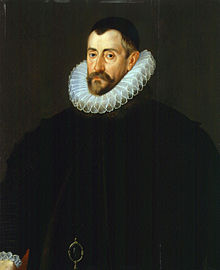 Sir Francis Walsingham, Queen Elizabeth’s principal secretary and spymaster and a secondary character in Murder in the Merchant’s Hall and the first book in the series, Murder in the Queen’s Wardrobe, appears in fictionalized form in a great many novels, so the challenge for me is to make my portrayal of him accurate but also distinct from what others have done. Here’s the tidbit I found to extrapolate from in Murder in the Merchant’s Hall: in August 1583, the queen sent Walsingham to Scotland on a diplomatic mission, and while he was there he fell ill. His poor health continued after his return to England in mid-October. It struck me that this might affect his ability to supervise his vast spy network and therefore offer one of his underlings an opportunity to advance his own agenda. From there it wasn’t much of a leap to imagine that this man’s plans could go awry and cause all kinds of difficulties for my fictional amateur detective, Rosamond Jaffrey.
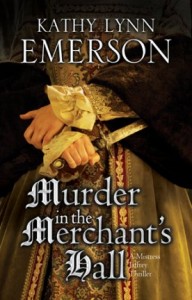 A big thanks to Kathy Emerson. She’ll give away an autographed hardback copy of Murder in the Merchant’s Hall to someone who contributes a comment on my blog this week. I’ll choose the winner from among those who comment by Friday at 6 p.m. ET. Delivery is available is the U.S. only.